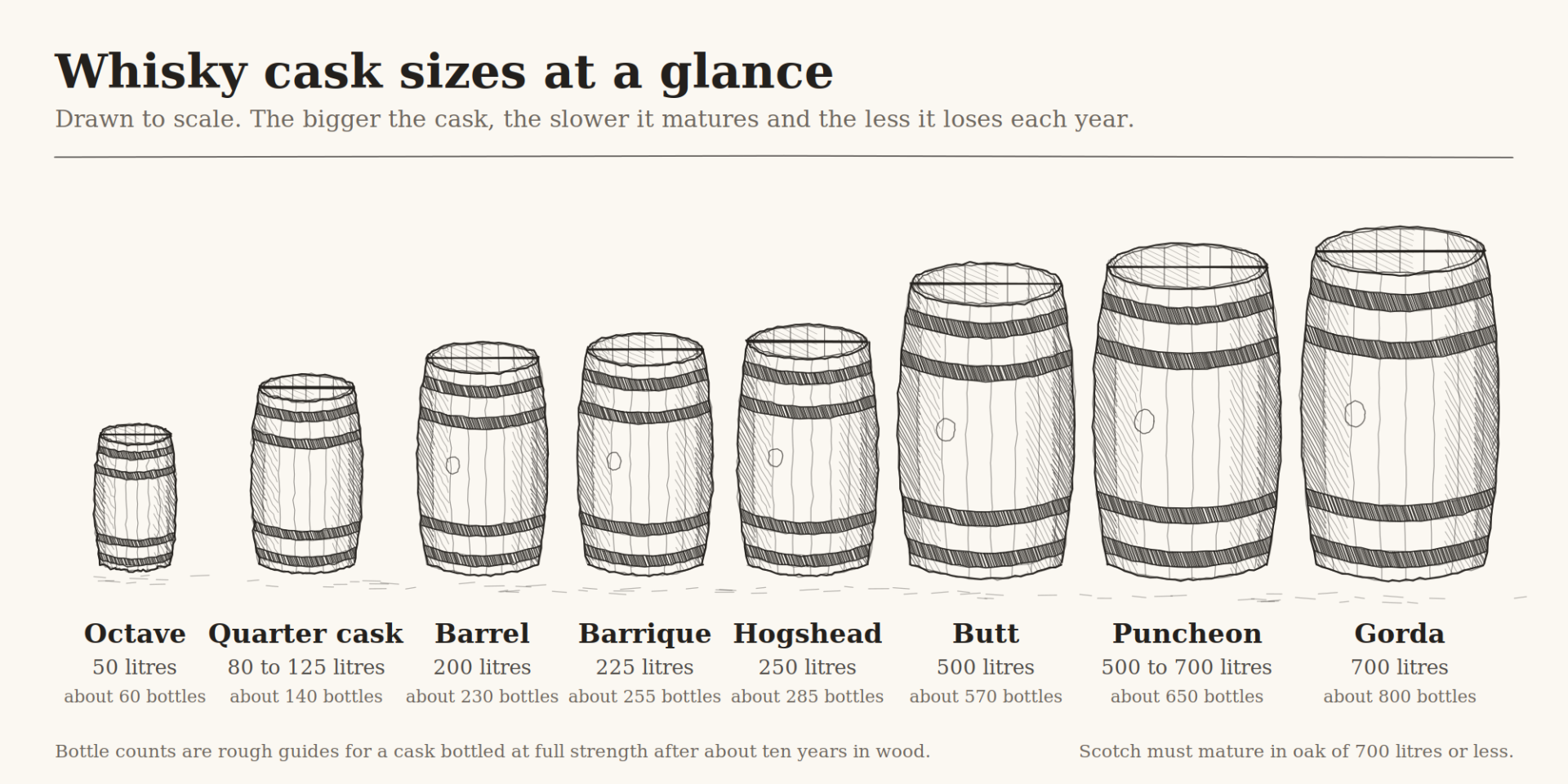
When people start looking at whisky casks as an investment, most of the early conversation goes to the distillery name and the year of fill. Those things matter. But the number that quietly shapes everything else, from how fast the whisky develops to how easy it is to sell later, is the size of the cask itself.
Cask size is not a detail. It sets your entry price, your holding period, how much liquid you lose every year, how many bottles you end up with, and how many buyers will be interested when you want out. Two casks filled on the same day at the same distillery can end up in very different places purely because one holds 200 litres and the other holds 500.
Here is a straight look at the common sizes and what each one is actually good and bad at.
First, the rule that sets the ceiling
If you are buying Scotch, the law caps the size. The Scotch Whisky Regulations 2009 say the spirit has to mature in oak casks with a capacity of no more than 700 litres. Anything bigger and it simply cannot be called Scotch. That is why the biggest cask you will ever be offered in Scotland is a gorda at 700 litres, and why nothing above that exists in the market.
There is no legal minimum, which is why you will see tiny casks around. Just be aware that very small casks sit outside what most distilleries and brokers treat as normal stock.
The one idea behind all of it
Everything about cask size comes down to a single relationship. The smaller the cask, the more of the whisky is touching wood at any given moment. More contact means faster change. Colour arrives sooner, flavour arrives sooner, and so does the point where the wood starts to dominate.
The flip side is loss. That same high contact means faster evaporation. In Scotland you can expect to lose roughly two percent of your volume a year on average, and small casks tend to run above that while big casks tend to run below it. Over ten years that difference compounds into real money.
So small is fast but leaky and easy to overshoot. Big is slow but steady and forgiving. Everything below is a variation on that theme.
Octave, around 50 litres
The baby of the family. An octave is often used for finishing rather than full maturation, and it will change a whisky quickly.
What is good about it. Cheapest way in by a mile. You will see results in a couple of years rather than a decade. Nice if you want a personal cask with your name on it and a few dozen bottles at the end.
What is not. Loss is high, so a long hold makes little sense. It is very easy to leave it too long and end up with something woody and bitter. Yield is small, maybe sixty odd bottles, so the economics rarely stack up once you add storage, insurance and bottling costs. And when you go to sell, the serious trade buyers are usually not interested in a cask this size.
Quarter cask, roughly 80 to 125 litres
Sizes vary a bit here depending on the cooper, but think of it as a small barrel built for speed.
What is good about it. Still a modest cheque. Matures noticeably faster than a full barrel, so you can be looking at a bottling decision in four or five years. Popular with small independent bottlers who want something distinctive.
What is not. Same problems as the octave, just softer. Higher evaporation, a narrower window before the wood takes over, and a resale market that is thinner than it is for standard sizes.
American Standard Barrel, around 200 litres
The workhorse. The ASB is the single most common cask in the Scotch industry, and if you buy one cask in your life it will probably be this one.
What is good about it. It is the market standard, and that is worth more than people realise. Standard means easy to price, easy to compare, easy to sell, and easy for a broker or bottler to slot into their plans. Maturation is well understood over ten to twenty years. Entry price is sensible. Yield is decent, often somewhere around 230 bottles at cask strength after a decade, depending on how the cask has behaved.
What is not. Because everyone has one, you are competing with a lot of similar stock when you sell. It also matures faster than the bigger formats, so a very long hold can thin the whisky out and leave you with less liquid than you hoped.
Barrique, around 225 litres
A wine world size that turns up in whisky reasonably often.
What is good about it. Sits close to a barrel in behaviour, so maturation is fairly quick and predictable. Slightly more liquid than an ASB for a similar sort of price.
What is not. It is not a native Scotch format, so buyers sometimes hesitate. Availability is patchy and pricing is less transparent than the standard sizes. Fine if you find a good one, but not something to hunt for.
Hogshead, around 250 litres
Built by taking barrel staves and rebuilding them into something a bit fatter. In practice this is the second most common cask you will meet.
What is good about it. A genuine sweet spot for a lot of buyers. Twenty five percent more liquid than a barrel for a fairly small step up in price, slightly slower and gentler maturation, and a resale market almost as deep as the ASB. Good balance of cost, yield and patience.
What is not. Not much, honestly. It costs more than a barrel up front, and because the format is rebuilt from older wood the quality of individual casks can vary more than you would like. Buy from someone who can tell you the cask history.
Butt, around 500 litres
The big traditional format, and the one most people picture when they imagine a warehouse.
What is good about it. Slow, patient maturation. Lower percentage loss each year, which really adds up over twenty or thirty years. Huge yield, often close to 570 bottles after a decade, which brings your cost per bottle right down. Casks of this size that hold well aged whisky are genuinely scarce, and scarce is where the money usually is.
What is not. The cheque is much bigger, so it is not an entry level buy. It takes longer to get interesting, which means your capital sits still for a long time. And when you sell, the pool of people who can write that size of cheque is smaller, so it can take longer to find your buyer even if the whisky is excellent.
Puncheon, roughly 500 to 700 litres
A broad family rather than one exact size. Some are short and fat, some are tall.
What is good about it. Big volume, slow maturation, low percentage loss. Same broad advantages as a butt.
What is not. The vagueness is the problem. Because a puncheon can mean several different things, you have to check the actual litre figure on the paperwork rather than trust the name. Pricing and resale are a little less clean as a result.
Gorda, 700 litres
The legal maximum for Scotch, and rare.
What is good about it. Maximum volume, the slowest and most forgiving maturation of anything you can legally use, and the lowest annual loss as a share of what is inside. Distilleries often use them for marrying whiskies together.
What is not. Very expensive, very rare, and awkward to handle physically. Maturation can be so slow that the whisky takes a long time to say anything at all. The resale market is tiny. This is a specialist purchase, not a first one.